

For decades, manufacturing has been chained to geography: giant factories in low-cost regions churn out parts, which then travel thousands of miles via ships, planes, and trucks to reach global markets. A single spare part for an airplane or a custom medical implant might take weeks to deliver, tying up capital in inventory and risking costly delays when demand spikes. But 3D printing is breaking that chain—turning the “distance tax” of traditional logistics into a relic of the past. By enabling distributed manufacturing—small, localized “micro-factories” near major markets that print parts on demand using digital files—this technology is redefining how goods are made and delivered. It’s not just a production upgrade; it’s a supply chain revolution that eliminates the need to ship physical products, replacing cargo ships with data streams.
Think of traditional manufacturing as a library that ships physical books to readers worldwide: slow, expensive, and wasteful if a book sits unused in transit or storage. Distributed 3D printing is like a digital library: anyone with a “printer” (micro-factory) can download a “book” (digital design file) and produce it instantly, no shipping required. This shift is transformative for industries where speed, customization, and cost efficiency matter most—especially aerospace and medical. In aerospace, for example, airlines and maintenance companies face a critical challenge: aircraft downtime costs $50,000-$200,000 per hour, and spare parts (like engine components or interior panels) often have lead times of 4-8 weeks. With micro-factories near major airports, airlines can receive digital files for these parts and print them in 4-24 hours, cutting downtime by 90% and eliminating the need to stockpile thousands of low-volume parts. A leading aerospace manufacturer already uses this model for 300+ components, reducing inventory costs by 60% and cutting carbon emissions from shipping by 75%.
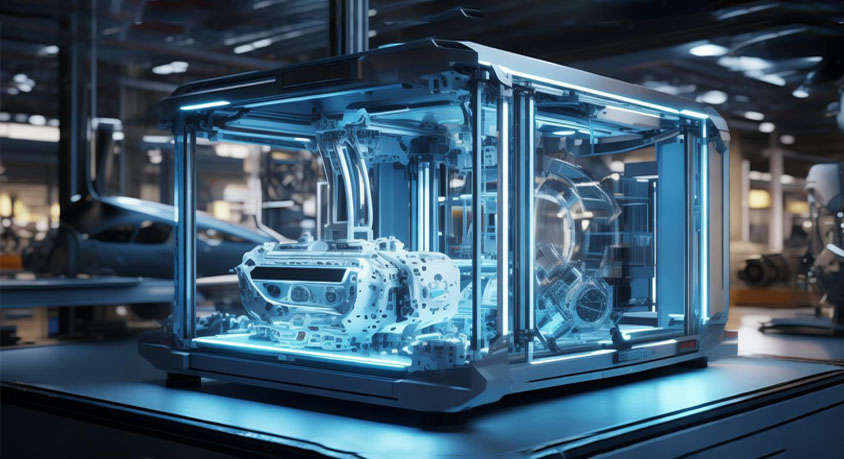
The medical field sees similar gains, where customization and speed can be a matter of life and death. Custom orthopedic implants (like hip replacements) or dental crowns traditionally require centralized production: a scan of the patient is sent to a factory, where the part is machined and shipped back—taking 3-5 days. With micro-factories in or near hospitals, clinicians can upload the scan, tweak the design, and print a perfectly fitted implant in 24 hours or less. This not only shortens patient wait times but also improves outcomes: 3D-printed implants have better biocompatibility and reduce surgical time by 20-30%, lowering infection risks. Data from U.S. and European hospitals shows that distributed 3D printing for medical devices cuts delivery costs by 40% and reduces implant rejection rates by 25% compared to traditional manufacturing.
The logistics math is irrefutable. Shipping a 1kg aerospace part from Asia to North America costs $50-$100 and takes 2-4 weeks. Sending a digital file of that part costs pennies and takes seconds, with the part printed locally for $10-$30 in materials. For low-volume, high-value parts—where traditional manufacturing requires expensive tooling and minimum order quantities—micro-factories eliminate waste entirely. They also adapt to demand spikes: during a natural disaster, a micro-factory can quickly print emergency medical supplies or infrastructure parts, bypassing disrupted supply chains. Even better, distributed manufacturing reduces carbon footprints: a 2023 study found that 3D-printed parts for aerospace cut lifecycle emissions by 40-60% compared to traditionally made, shipped parts.
This model isn’t just for niche applications—it’s scaling fast. Major aerospace companies have deployed 20+ micro-factories across Europe, Asia, and North America, while medical device firms are partnering with hospitals to set up on-site printing labs. The key enablers are twofold: advances in 3D printing materials (high-strength plastics, titanium, and even biocompatible resins) that match the performance of traditionally made parts, and cloud-based design platforms that securely share files and ensure quality control across micro-factories. By 2030, analysts predict that 25% of all aerospace and medical parts will be produced via distributed 3D printing, with micro-factories becoming as common as warehouses are today.
3D printing’s true power isn’t in making parts faster—it’s in making them closer. By decoupling production from geography, distributed manufacturing eliminates the inefficiencies of long-distance logistics, turning “wait for it” into “make it now.” For businesses, this means lower costs, faster delivery, and less risk. For consumers and patients, it means better, more accessible products. The “death of distance” in manufacturing isn’t a futuristic concept—it’s happening today, one micro-factory and one digital file at a time. Traditional supply chains built on shipping physical goods are being replaced by something faster, cheaper, and more sustainable: a world where distance no longer dictates how and where things are made.
Disclaimer: Mention of any brand or trademark is for identification purposes only and does not indicate any partnership or endorsement.
