

You open your fridge. Nothing beeps. No screens flash. Still, somehow your smart kitchen knows you’re low on eggs. Ambient computing works like that—quiet, patient, mostly invisible. It’s the kind of technology you notice only when it doesn’t work.
Walk around an apartment outfitted with these systems and you start noticing small nudges. Lights shift subtly as you move from room to room. The heating system kicks in without a thought. Some days, I joke that my home knows me better than I know myself. Other days, the thermostat overshoots by a couple of degrees and I feel like the house is guessing too hard. That unpredictability is part of the experience—machines trying to think ahead, sometimes failing, sometimes impressively right.
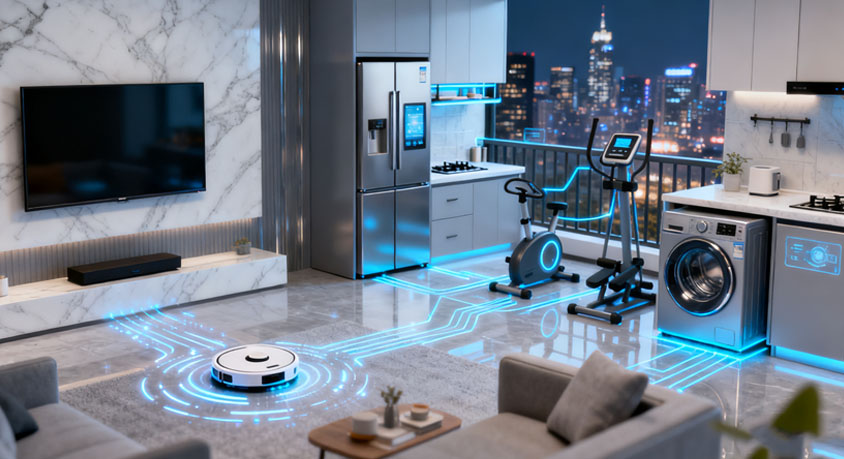
Ambient computing isn’t one product. It’s a web of sensors, AI algorithms, and invisible networks. A wireless hub in the corner gathers motion, temperature, even background noise. Algorithms translate that into actions: lights dim, music starts, coffee begins brewing. Voice commands are optional. You could say “I’m cold” or just shiver, and in some setups, the system interprets it. The term “ambient” matters—it’s not a display, it’s not a gadget, it’s the environment itself adapting.
Some mornings it’s almost spooky. You walk in after a late-night shift, and the apartment has already warmed up, lights softened, playlist cued. You didn’t touch a thing. That’s the appeal: small frictions removed from daily life. Yet, it’s not perfect. Sometimes motion sensors think a cat is a human. Sometimes reminders arrive hours too early. But the cumulative effect is noticeable: your life subtly smoothed, micro-friction eliminated, not replaced, just optimized.
Kitchens are laboratories for this. A countertop could suggest recipes, track pantry items, or even hint at leftover meals about to spoil. One experimental home noted about 60% of suggestions were actually used. Not a perfect success rate, but significant enough to reduce wasted food and mental load. For someone juggling work emails and kids’ schedules, that’s not trivial. These systems can’t cook or clean alone, but they can anticipate small repetitive tasks, saving minutes you didn’t realize you’d lose each day.
Transportation has its own ambient layer. Cars now can sense driver stress, adjust cabin lighting, or tweak music based on driving patterns. Ride-sharing apps might predict where you’ll need a pickup, not because you asked, but because patterns emerge from calendars, location history, and traffic flow. You barely notice until the notification is timed perfectly. Or mistimed, which is where the humor often comes in: a system so context-aware it occasionally misreads signals, and you laugh at the tiny mismatch between life and algorithm.
Privacy is the shadow side. Sensors always listening, always tracking. The more ambient computing infiltrates, the more we rely on data we can’t fully see. Some people disable microphones at night. Others segment devices on separate networks. There’s no magic bullet; it’s a dance of trust. You slowly teach the system boundaries while it slowly teaches you how much control is really optional. It’s like cohabiting with an intelligent roommate you barely see, but who remembers everything.
Interface design shifts entirely. No screens, no buttons, just subtle cues. A light shifts color, a gentle vibration from a wearable, the tone of music changes—these are notifications without traditional alerts. I’ve experienced a setup where room temperature was communicated purely by light color. At first, it was confusing. Blue? Red? Now, weeks later, glance at the room, and I “feel” the temperature without a thermometer. Ambient computing leverages intuition rather than instruction.
Even small routines are affected. Vacuum cleaners map spaces and act while you do other things. Sensors track energy consumption silently, nudging appliances off when idle. Thermostats adjust gradually. The beauty is in absence—the less you see, the more the system works. And yes, it still fails sometimes: a pet triggers a cleaning cycle at 3 a.m., or a sensor misreads humidity. But those quirks become part of the rhythm, the tiny human-machine stories you tell yourself later.
The philosophy shifts: instead of learning to use technology, technology learns you. Devices disappear into space and habit. They anticipate rather than respond. It’s a mental shift—trusting a system that is intentionally invisible. And the odd thing is, humans adapt. We start noticing the gaps, not the presence. Ambient computing teaches patience, observation, and micro-trust.
Perhaps the most tangible feeling is absence. You stop noticing the buttons, panels, or alerts. Yet life runs slightly smoother. That’s ambient computing: not a single device, not a flashy display, not an assistant in front of you. Just an environment quietly shaping itself to your rhythms. The technology is everywhere, but the interaction fades. You live, it adjusts, mostly unnoticed. And in that invisibility, it becomes almost natural. Almost human.
Disclaimer: Mention of any brand or trademark is for identification purposes only and does not indicate any partnership or endorsement.
